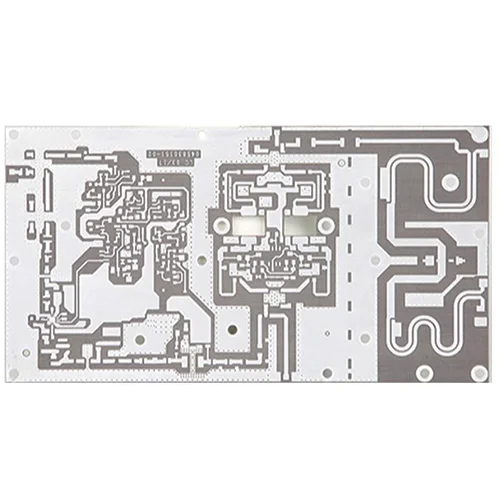
TACONIC PCB
Taconic PCB is a printed circuit board manufactured using Taconic PCB material. These materials are ceramic filled teflon and glass fiber reinforced materials. These boards are suitable for RF applications in the communications and aerospace industries.
| Layers | 2L |
| Copper Thickness | 1oz |
| Plate Thickness | 0.8MM |
| Minimum line width | 0.7MM |
| Minimum line spacing | 0.25MM |
| Surface treatment | Immersion Tin |

Prototype to Full Turn-Key Assembly

Through-Hole Lead-Free Wave Soldering

Best Price, Genuine Components

Quality Accreditation ISO9001
-
Description
-
Specification
Taconic PCB: What does it mean?
Taconic PCB is a printed circuit board manufactured using Taconic PCB material. These materials are ceramic filled teflon and glass fiber reinforced materials. These boards are suitable for RF applications in the communications and aerospace industries.
This printed circuit board has low dielectric loss and electrical signal loss, making it ideal for a variety of applications. This circuit board is designed to meet the ever-increasing demands of the electronics world. Taconic PCBs are available in a wide range of dielectric constant values.
Taconic is a well-known brand in the field of RF laminates. It provides printed circuit boards for the manufacture of high-performance digital boards, multilayer RF and other electronic devices. Taconic laminates can be milled, plated and cut using standard methods.
What is the difference between Taconic PCB and Isola PCB?
Many people wonder what is the difference between Taconic and Isola PCB. These two types of printed circuit boards have similar advantages, but are different from each other. Taconic PCBs utilize ceramic filled PTFE or glass reinforced PTFE PCBs, making them thermally and electrically stable.
Taconic panels utilize thermoplastic prepregs and thermosets to meet the needs of high performance panels. These boards are ideal for microwave or RF designs.
Meanwhile, Isola PCB is manufactured using copper clad laminates and dielectric prepregs. These laminates have resin compositions to meet the demands of high performance applications. Isola PCBs have excellent mechanical, thermal and also electrical properties. These properties provide more than FR-4 materials.
Taconic and Isola PCBs are designed for high-speed and high-performance applications, but these boards also use different materials in production.
Advantages of Taconic PCB
Low cost: When making such circuit boards, low cost is required. It’s always a budget-friendly option for engineers. This ceramic-filled laminate offers excellent value for money.
Low dielectric loss: Low dielectric loss laminates are ideal for RF and microwave applications. Taconic has very low dielectric losses. The low dielectric loss of this material is a result of the dielectric constant of this material.
Low electrical signal loss: This is a great advantage of these boards. Taconic laminates also offer low dielectric signal loss due to the materials used in their manufacture.
Wide range of dielectric constants: Taconic PCB offers a wide range of dielectric constants. This makes it ideal for use in a variety of applications.
Low dissipation factor: This circuit board has a low dissipation factor and is a good insulating material. A low dissipation factor indicates an efficient insulator system.
Excellent Dimensional Stability: Taconic PCB retains its original size even when exposed to heat. Engineers use this board for applications that may be exposed to different temperatures.
Low Moisture Absorption: The board has low moisture absorption. Therefore, it can be used in wet environments. Moisture is detrimental to the durability of PCBs, so PCBs that absorb low moisture are ideal.
Factors to Consider in Taconic PCB Hybrid Manufacturing
There are some factors to consider in the hybrid manufacturing process of Taconic PCB i.e. Taconic rf 35 PCB.
Drilling Parameters: Drilling parameters are a key factor to consider as it determines the correct drill hole formation. The feed and speed of the drill are determined by the stack material. During hybrid manufacturing, speed and feed need to be adjusted. For example, some components emit a lot of heat, which can lead to deformation.
Compatible Materials: Materials used in a hybrid layup should match the lamination cycle. Some materials require higher temperatures and pressures during lamination. Before using a material in a design, you should always check the material’s data sheet to confirm the purpose of the material.
Prepare the hole wall: After drilling, the next step is to prepare the hole wall. For each Universal Group, there may also be process instructions. You must improve the process of each material for total reliability.
| Feature | Capability |
|---|---|
| Material | FR-4 Standard Tg 140°C, FR4-High Tg 170°C |
| Min. Track/Spacing | For External layers: 4oz Cu 10mil/13mil, 5oz Cu 12mil/15mil, 6oz Cu 15mil/15mil For Internal layers: 4oz Cu 8mil/8mil, 5oz Cu 10mil/10mil, 6oz Cu 12mil/12mil |
| Min. Hole Size | 0.15 ~ 0.3mm |
| Max Outer Layer Copper Weight (Finished) | 12oz |
| Max Inner Layer Copper Weight | 12oz |
| Board Thickness | 0.6-6mm |
| Surface Finishing | HASL lead-free, Immersion gold, OSP, Hard Gold, Immersion Silver, Enepig |
| Solder Mask | Green, Red, Yellow, Blue, White, Black, Purple, Matte Black, Matte green |
| Silkscreen | White, Black |
| Via Process | Tenting Vias, Plugged Vias, Vias not covered |
| Testing | Fly Probe Testing (Free) and A.O.I. testing |
| Build time | 5-15 days |
| Lead time | 2-3 days |